
Facades in Dubai carry more regulatory burden than any other building element. They sit at the intersection of fire safety, energy performance, structural loading, and aesthetic control—four separate regulatory domains, each governed by a different authority or code section, each with its own submission and approval track. A facade system that satisfies Dubai Civil Defence on fire rating may fail Al Sa’fat on thermal performance. A glazing ratio that meets energy modelling targets may violate orientation rules. A cladding material that clears structural wind load calculations may be rejected on durability grounds during the building permit review.
Understanding where these requirements overlap and where they conflict is what separates a smooth approval process from one that stalls in circular revisions. At Merka, our authority approvals team coordinates facade compliance across all four domains simultaneously, because addressing them in sequence—fire first, then energy, then structure—almost always produces contradictions that require rework.
The Dubai Building Code and Facade Requirements
The Dubai Building Code (DBC), published by Dubai Municipality in its first unified edition in 2020, consolidates what was previously a patchwork of circulars, by-laws, and referenced international standards. Before the DBC, design teams pieced together compliance from the UAE Fire and Life Safety Code, British Standards, ASTM references, and individual DM circulars—sometimes encountering contradictions between documents issued years apart.
For facades specifically, the DBC sets requirements across several chapters. Structural provisions reference ASCE 7 for wind load calculations, with design wind speeds calibrated to Dubai’s geography (3-second gust speeds of 45 m/s for a 50-year return period are commonly used for towers, though values vary by height and exposure category). The code requires that cladding dead loads be specified in permit drawings, and allows reduction from tabulated values only when actual system loads are calculated and submitted for review. Material provisions require compliance with referenced standards for concrete, steel, aluminium, glass, and stone—each with its own testing and certification pathway.
Free zones add a jurisdictional wrinkle. Projects in DIFC, JAFZA, Dubai Silicon Oasis, and other free zones fall under Trakhees rather than Dubai Municipality, with their own building control departments and—in some cases—their own supplementary requirements. The underlying code is broadly aligned, but submission formats, review timelines, and inspection protocols differ. Architects who assume DM procedures apply uniformly across Dubai discover otherwise during the first submission.
Cladding Fire Safety and Dubai Civil Defence
After a series of high-rise facade fires between 2012 and 2017—including incidents at Tamweel Tower in JLT, The Torch in Dubai Marina, and the residential tower adjacent to Burj Khalifa on New Year’s Eve 2015—the UAE overhauled its cladding regulations. The UAE Fire and Life Safety Code of Practice, updated in 2017 and amended in subsequent circulars, now bans combustible aluminium composite panels (those with polyethylene cores) on buildings above 15 metres. All cladding panels must be tested as a complete assembly—not as individual components—and certified as capable of preventing the spread of fire, heat, toxic gases, and smoke.
Dubai Civil Defence (DCD) enforces these requirements through a dedicated facade review process. The cladding supplier must be registered and licensed with DCD. The cladding system must be tested and certified by an accredited body. The facade installer must be licensed by DCD and trained by the system supplier. A fire consultant (registered as a “House of Expertise” with DCD) must review the facade design and inspect the installation. The fire consultant submits a facade fire assessment report to DCD before installation begins on site. Missing any step in this chain—supplier registration, assembly testing, installer certification, fire consultant review—triggers a stop-work order.
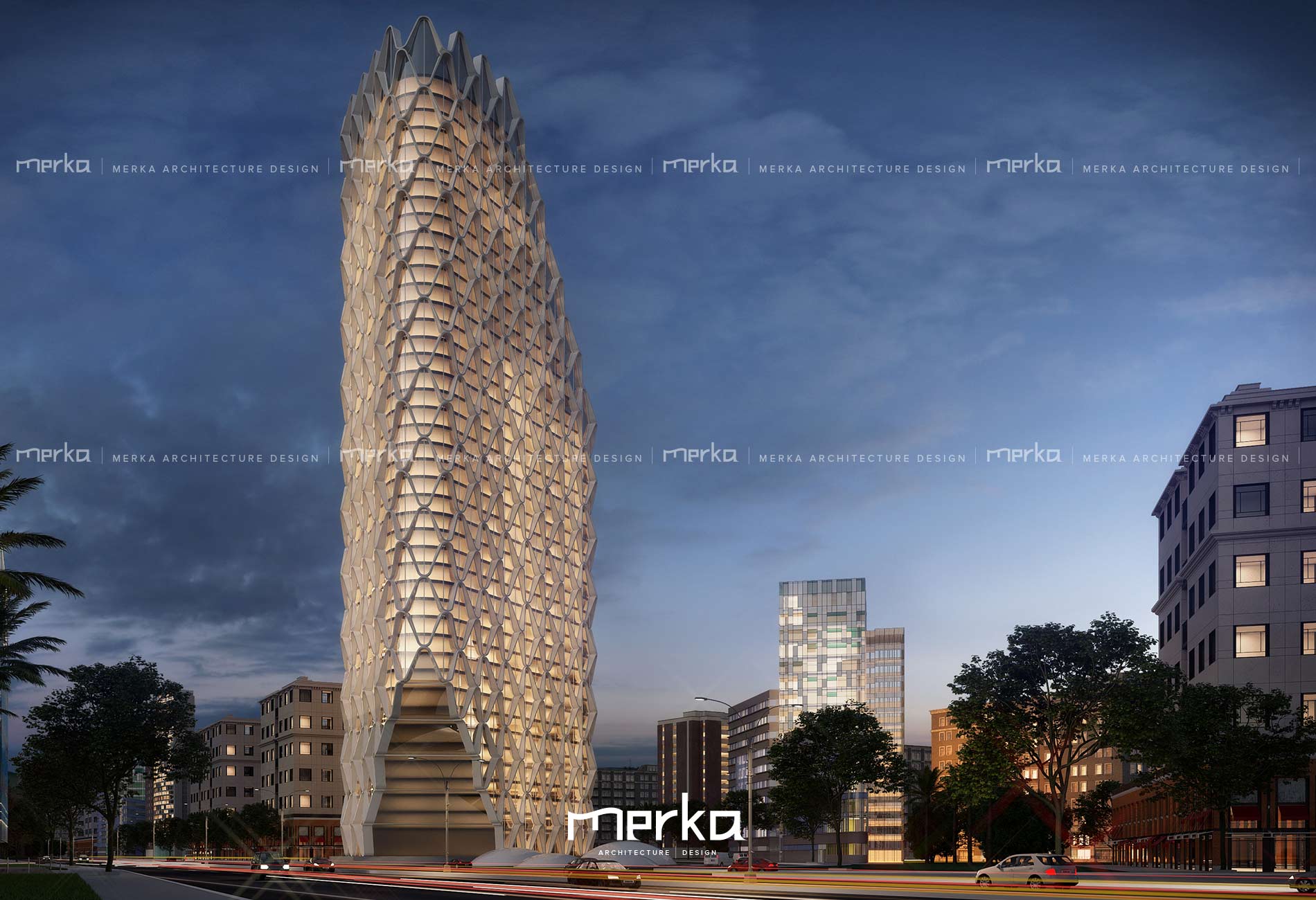
For projects with non-standard facade geometries, fire testing becomes more involved. When Merka designed the Lattice Tower Hotel in Business Bay—a 65,000–75,000 sqm tower wrapped in a geometric exoskeleton that doubles as structural bracing and solar shading—the facade fire assessment had to account for the exposed structural lattice, the glazed infill panels behind it, and the air gap between the two layers. Standard test data for flat curtain wall systems did not apply. The fire consultant had to evaluate the assembly based on the specific geometry, materials, and ventilation pathways of the lattice system. Understanding material durability in tandem with fire performance prevents late-stage material substitutions that compromise one requirement while satisfying another.
Al Sa’fat and Facade Thermal Performance
Dubai’s Al Sa’fat Green Building System (second edition, January 2023) grades buildings from Bronze to Platinum based on energy, water, material, and indoor environment criteria. Bronze is mandatory for all new construction in Dubai Municipality jurisdiction. Facades take the heaviest share of the energy compliance burden, because in a climate where cooling accounts for 60–70% of a commercial building’s energy consumption, the building envelope is the first line of defence against solar heat gain.
Two compliance routes exist for energy performance: the Elemental Method and the Performance Method. Under the Elemental Method, individual facade components must meet prescriptive U-value and solar heat gain coefficient (SHGC) thresholds. Under the Performance Method, the building’s total annual energy consumption is modelled dynamically (per ASHRAE 90.1 Appendix G) and compared against a reference building of equal size and shape that meets all elemental requirements. The Performance Method allows more design freedom—a higher glazing ratio on one elevation can be offset by better-performing glass or deeper shading on another—but requires energy modelling from a specialist consultant.
Al Sa’fat also includes an orientation rule that affects facade design directly: for non-villa buildings, at least 50% of the total glazed surface area (excluding spandrel panels with back insulation) must face the angle between north and east. South and west glazing is not prohibited, but it must be justified through the energy model, which is harder to achieve as glazing ratios on those exposures increase. This rule has a direct bearing on floor plate orientation and core placement decisions made during the earliest design stages. The thermal demands vary significantly between coastal and inland sites—humidity and salt on the coast, thermal cycling and dust further inland—and the facade build-up must respond to both the Al Sa’fat energy targets and the environmental exposure specific to the site.
Wind Load and Structural Facade Requirements
Dubai’s tower inventory creates its own wind environment. Tall buildings accelerate wind at street level through channelling effects, and neighbouring towers can amplify or redirect wind pressure on a new building’s facade in ways that differ significantly from open-exposure assumptions. The DBC requires wind load calculations per ASCE 7 or Eurocode, and for towers above a certain height (typically 60–80 metres, depending on the consultancy and the authority reviewer), a project-specific wind tunnel study is expected.
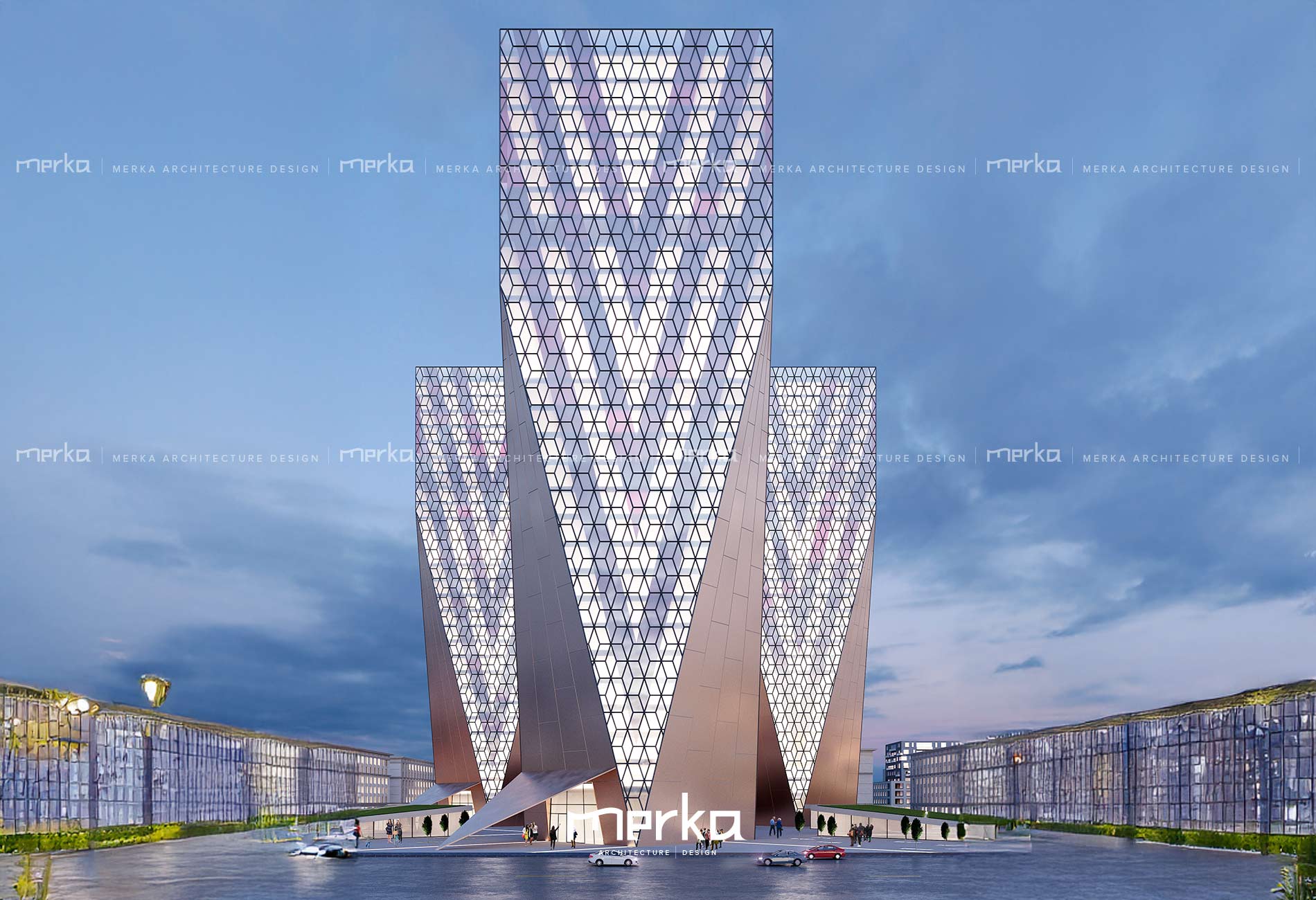
Wind tunnel testing determines pressure coefficients on each facade zone—positive pressure on the windward face, suction on the leeward face, and complex pressure patterns at corners and setbacks. These coefficients feed directly into the curtain wall engineer’s calculations for mullion sizing, anchor bolt spacing, glass thickness, and seal profiles. For Merka’s Triad Business Towers—three towers totalling 180,000–220,000 sqm with a tessellated glass skin—the faceted geometry of each tower face produces pressure distributions that flat-facade assumptions underestimate at corners and overestimate at mid-panel zones. Accurate wind data allowed the curtain wall system to be optimised zone by zone, reducing material weight and cost on low-pressure areas without under-specifying high-pressure zones. Applying passive design strategies to a facade requires knowing exactly where the wind loads concentrate so that operable shading or ventilation elements are structurally adequate.
Aesthetic Control and Master Developer Guidelines
Beyond the DBC, Al Sa’fat, and DCD, facades in Dubai must also satisfy master developer guidelines wherever the project sits within a planned community. Emaar, Nakheel, Meraas, Dubai Holding, Wasl, DAMAC, and other developers maintain design review committees that control facade material palettes, colour ranges, signage placement, lighting design, and sometimes even the proportional relationship between solid wall and glazing. These guidelines are contractual rather than statutory—they derive from the master community’s design code, not from the DBC—but rejection by the developer’s design review committee blocks the project just as effectively as a DM objection.
Projects that push facade boundaries need early engagement with the developer’s review team. Parametric facade design—non-repetitive panel geometries, algorithmically varied perforation patterns, or structurally expressed exoskeletons—falls outside the standard palette that most developer guidelines anticipate. Presenting the design logic clearly—solar analysis data, energy model outputs, wind pressure diagrams—shifts the conversation from “does it match the community character” to “does the performance data support the departure.” Merka resolves these negotiations during design development, before detailed facade engineering begins.
Coordinating Across Four Regulatory Domains
The practical difficulty of facade compliance in Dubai is not any single requirement—each one is clear enough in isolation. The difficulty is that changes to satisfy one domain ripple into the others. Reducing glazing area to meet Al Sa’fat energy targets changes the facade’s weight, which changes the structural connection design, which changes the fire compartmentation strategy if the spandrel height drops below the minimum non-combustible zone between floors. Substituting an aluminium composite panel to reduce weight may trigger a new DCD fire test requirement. Adding external shading fins to improve SHGC changes the wind pressure profile on that facade zone.
Managing these interactions requires a single coordinated facade strategy, modelled in BIM where the architectural, structural, MEP, and fire engineering models share the same geometry. When the mullion profile changes in the structural model, the energy model picks up the thermal bridge; when the glass specification changes for SHGC, the structural model recalculates the dead load. Without this coordination, each discipline works from assumptions that diverge over time, and the discrepancies surface during authority review—where they become revision cycles rather than design decisions. Merka’s construction documentation process embeds these cross-disciplinary checks before drawings leave the office, reducing the revision load during permit review.
Facade compliance in Dubai touches every stage of a project, from the first site analysis through construction inspection. If you’re planning a tower, mid-rise, or mixed-use project in Dubai, you can see how we approach facade-intensive work in our project portfolio, or get in touch to discuss your project’s facade strategy and approval pathway.
Frequently Asked Questions
What cladding materials are banned in Dubai?
Combustible aluminium composite panels (ACPs) with polyethylene cores are banned on buildings above 15 metres under the UAE Fire and Life Safety Code of Practice, updated in 2017. All cladding systems on new buildings must be tested as a complete assembly and certified as non-combustible by an accredited testing body. The cladding supplier, installer, and fire consultant must all be registered and licensed with Dubai Civil Defence before work begins.
What is the Al Sa’fat Green Building System, and how does it affect facades?
Al Sa’fat is Dubai Municipality’s mandatory green building rating system, grading buildings from Bronze (mandatory minimum) to Platinum. Facades are central to compliance because building envelope performance drives cooling energy demand. The system sets prescriptive U-value and SHGC limits for facade components, and requires at least 50% of glazed surface area to face between north and east for non-villa buildings. An alternative Performance Method allows designers to trade off higher glazing on one elevation against better performance elsewhere, using dynamic energy modelling per ASHRAE 90.1.
Do I need a wind tunnel test for my building’s facade in Dubai?
Wind tunnel testing is not universally mandatory under the DBC, but it is expected for towers above approximately 60–80 metres and for buildings with unusual geometries or locations near other tall structures. The test determines facade zone-specific pressure coefficients that feed into curtain wall engineering calculations for mullion sizing, anchor design, glass thickness, and seal profiles. Standard code calculations based on open-exposure assumptions often underestimate pressures at corners and overestimate them at mid-panel zones, which is why project-specific data is preferred by both the design team and the authority reviewer.
What is the role of Dubai Civil Defence in facade approvals?
Dubai Civil Defence (DCD) runs a dedicated facade review process separate from the Dubai Municipality building permit. DCD requires the cladding supplier to be registered and licensed, the cladding system to be tested and certified as an assembly, the facade installer to be DCD-licensed and supplier-trained, and a registered fire consultant (House of Expertise) to review the facade design and inspect installation. The fire consultant submits a facade fire assessment report to DCD before installation begins. Missing any step causes a stop-work order.
Are facade rules the same in Dubai free zones?
The underlying code requirements are broadly aligned, but projects in free zones such as DIFC, JAFZA, and Dubai Silicon Oasis fall under Trakhees rather than Dubai Municipality. Trakhees has its own building control departments, submission formats, review timelines, and inspection protocols. Some free zones have supplementary facade requirements. Architects should confirm the governing authority and any zone-specific additions before finalising the facade specification and submission package.
How do master developer design guidelines affect my facade?
Major Dubai developers—Emaar, Nakheel, Meraas, Dubai Holding, Wasl, DAMAC—maintain design review committees that control facade material palettes, colour ranges, signage, lighting, and glazing proportions within their communities. These guidelines are contractual (derived from the community design code) rather than statutory (from the DBC), but rejection by the developer’s review committee blocks the project just as effectively as a Dubai Municipality objection. Non-standard facades require early engagement and performance data to justify departures from the standard palette.


