
Building Information Modelling in the UAE has passed the point where it could be treated as a technology add-on. Since January 2024, Dubai Municipality requires BIM model submissions for building permits on projects above certain thresholds. Abu Dhabi has referenced BIM deliverables in government procurement for over a decade. Consultants who treat BIM as a visualisation tool bolted onto traditional 2D production are already running into friction with both the authorities and the construction teams who need coordinated data, not rendered images.
At Merka, BIM runs through every stage of architectural production. It starts at concept design and extends through to the permit-ready construction documentation package that leaves the office. The model is the design. The drawings extracted from it are records of decisions already tested in three dimensions. That distinction—between a model that generates drawings and drawings that get modelled after the fact—determines whether BIM saves time or adds it.
Dubai Municipality’s BIM Mandate
Dubai Municipality first introduced BIM requirements in 2013 through Circular 196, which applied to architectural and MEP work on government buildings and large projects. Circular 207 followed in 2015, extending the scope. The most recent mandate, Circular 9-1-2 (October 2023, effective January 2024), requires 3D BIM model submissions in IFC format for building permit applications on four categories of project: buildings exceeding 20 floors (architectural BIM) or 40 floors (structural BIM); complexes with a total area above 20,000 sqm (architectural) or 30,000 sqm (structural); specialised buildings such as hospitals and universities; and all government projects regardless of size.
The IFC (Industry Foundation Classes) format requirement is significant. IFC is an open, vendor-neutral file standard maintained by buildingSMART International, and Dubai Municipality’s adoption of it means that permit reviewers receive a model they can interrogate independently of whatever software the design team used. Revit, ArchiCAD, Tekla, and other authoring tools can export IFC, but the quality of the export varies—geometry that looks correct in the native software can arrive at the authority with missing elements, incorrect classifications, or broken spatial relationships if the IFC export is not configured properly. The Dubai BIM Standards, developed alongside ISO 19650 principles, specify naming conventions, geo-referencing requirements, and information content that the IFC model must satisfy. Getting this right is a technical task, not a clerical one.
Multi-Discipline Coordination on Large Projects
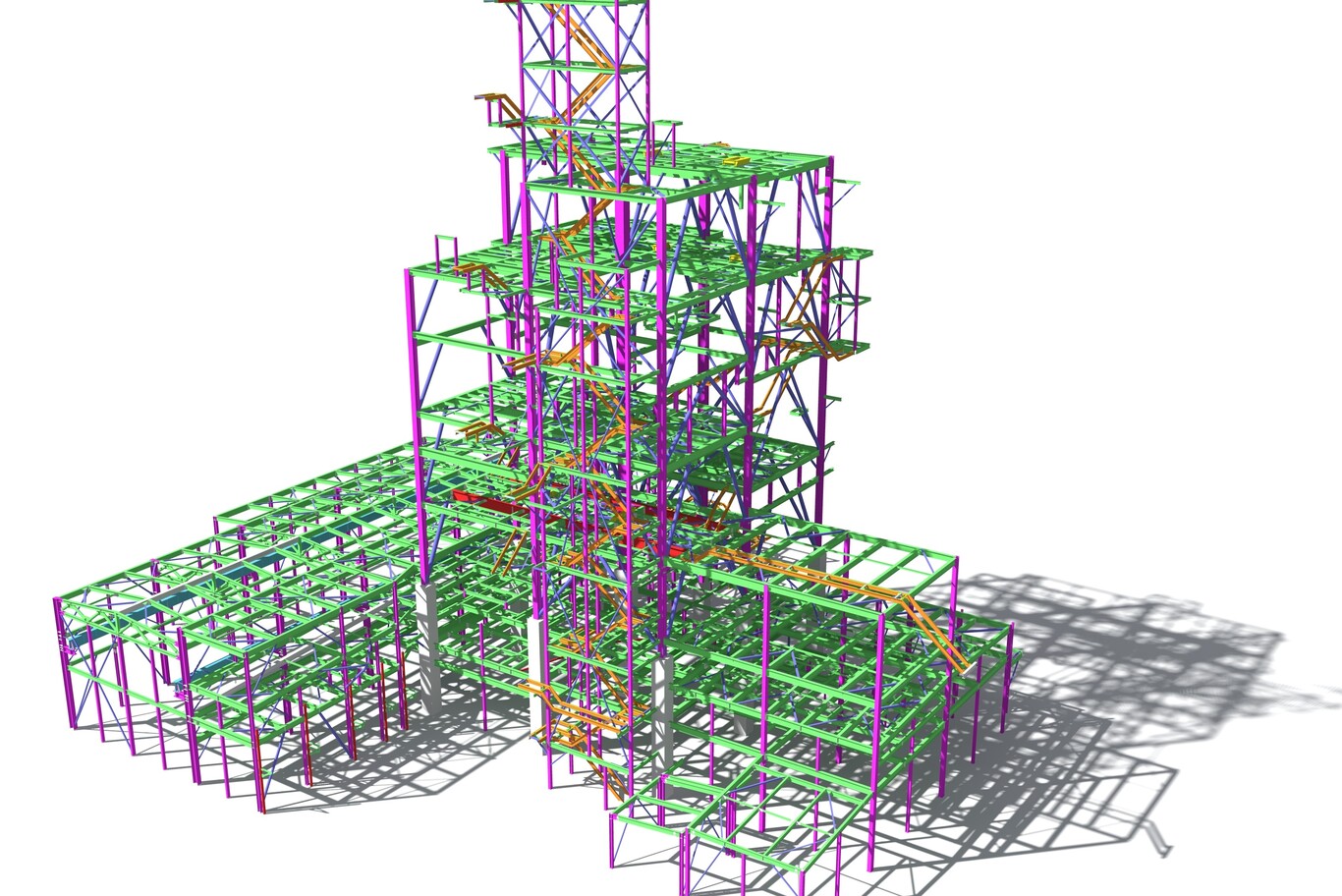
The real payoff from BIM comes during multi-discipline coordination—the phase where the architectural, structural, MEP, and facade models are federated (combined without merging) and checked for conflicts. On a typical UAE commercial project, the clash detection process runs automated rules that flag geometric intersections: a duct passing through a beam, a cable tray colliding with a sprinkler pipe, a drainage line crossing a post-tensioned slab band where core drilling is prohibited. Each clash that gets resolved digitally is a request for information (RFI) that never gets written on site, a delay that never happens, and a cost that never materialises.
The volume of coordination scales with project complexity. On Merka’s Corniche Orbital Mall and Cultural Complex—two elliptical landmark buildings totalling 180,000–210,000 sqm on the Abu Dhabi waterfront—the architectural model alone contains curved structural envelopes, double-height retail voids, back-of-house service corridors, and a cultural facility with distinct acoustic and environmental requirements. Layering the structural frame, MEP distribution, vertical transportation, and fire compartmentation models on top produces thousands of potential clash points. Without BIM federation, these conflicts surface during construction as RFIs, change orders, and programme delays. With federation, they surface during design development, where resolving them costs hours instead of weeks.
BIM for Facade Engineering Coordination
Facades concentrate the highest density of inter-disciplinary interfaces in any building. The curtain wall mullion attaches to the structural slab edge. The spandrel panel must align with the fire compartmentation line between floors. The vision glass specification affects the MEP cooling load calculation. The external shading device adds wind load to the structural connection. If any of these elements moves in one discipline’s model without updating the others, the facade arrives at site with misalignments that require field modifications—the most expensive kind of fix.
When Merka developed the facade system for the Triad Business Towers—three towers spanning 180,000–220,000 sqm with a tessellated glass skin that reflects light differently across each faceted panel—the BIM model was the coordination backbone. Each faceted panel has a unique angle relative to the structural grid, which means every panel-to-mullion connection, every mullion-to-slab-edge bracket, and every thermal break detail had to be verified against the structural and MEP models before shop drawings were issued. Doing this in 2D would have required a separate verification drawing for every unique panel condition. In BIM, the federated model flags deviations automatically. The same principle applies to facade design regulations compliance, where fire-rated zone heights between floors can be checked across the entire building perimeter in a single automated rule, rather than verified floor-by-floor on flat drawings.

BIM on Multi-Building Campus Projects
Campus projects multiply the coordination challenge because separate buildings share site-wide systems: stormwater drainage networks, electrical distribution from a central substation, district cooling pipework, vehicular and pedestrian circulation routes, and landscape irrigation. Each building carries its own BIM model, but the site-wide infrastructure must be modelled as a federated layer that checks for clashes across building boundaries—where a chilled water main from the central plant crosses under a landscape retaining wall, or where the fire access road clearance conflicts with a canopy structure.
Merka’s Government Administration Complex in Abu Dhabi—a 14,000–18,000 sqm campus containing a ministry headquarters, a formal reception villa, a mosque, a modern majlis, and secured support buildings—required exactly this kind of campus-level BIM coordination. The mosque’s qibla orientation rotated it relative to the campus grid, which meant every service connection between the mosque and the central plant crossed the site at an angle that conflicted with the primary vehicular route. Without the federated site model, that conflict would have surfaced during excavation. With it, the service routing was adjusted during the design phase, and the authority submissions package reflected the resolved design from the first permit application.
BIM Beyond the Design Phase
BIM’s value extends past permit submission. During tender, quantity surveyors extract material quantities directly from the model rather than measuring from drawings—a process that is faster, more accurate, and auditable because every quantity traces back to a modelled element with defined properties. During construction, the model serves as the coordination reference for site teams, who can query it on tablets to understand complex junctions that are difficult to read on 2D sections. During handover, the model becomes the foundation of the asset information model (AIM), which the building’s facilities management team uses for maintenance planning, space management, and future fit-out coordination.
Each of these downstream uses depends on the quality of information loaded into the model during design. A model that contains geometry but no material specifications, no fire ratings, no maintenance access requirements, and no equipment data sheets is useless for quantity extraction, construction coordination, and facilities management. At Merka, BIM information requirements are defined during authority approvals scoping—before modelling begins—so the team builds to a defined standard rather than backfilling data at the end. The same data-first approach applies to value engineering: when the model contains accurate material properties and quantities, alternative specifications can be evaluated against the original on cost, weight, and performance simultaneously, rather than requiring separate manual take-offs for each option.
Where BIM Integration Fails and How to Prevent It
BIM fails when it is adopted as a production tool without changing the design process. The most common failure mode is a practice that produces 2D drawings first, then builds a 3D model afterwards to satisfy the DM submission requirement. The model in that case is a duplicate of the drawings, not the source of them. It adds time, it introduces discrepancies between the 2D and 3D deliverables, and it defeats the purpose of clash detection because the model is created too late to influence design decisions.
The second failure is poor LOD (Level of Development) management. A model with every element at LOD 400 (fabrication-level detail) from day one is unwieldy, slow, and distracts the team with detail that belongs in later stages. A model that stays at LOD 100 (conceptual massing) through schematic design misses the structural and MEP coordination that should happen at LOD 200–300. Getting the LOD progression right—concept at LOD 100, schematic at LOD 200, design development at LOD 300, construction documentation at LOD 350—means the model grows at the same pace as the design decisions, and clash detection happens at the stage when each discipline has enough detail to make meaningful checks.
The third failure is treating BIM as an architect’s tool rather than a project-wide platform. If the structural engineer works in a separate model that never gets federated with the architectural model until permit submission, the coordination benefit is lost. BIM works when every discipline contributes to and coordinates through the same federated environment, with regular clash detection cycles built into the project schedule—typically fortnightly during design development and weekly during construction documentation.
BIM coordination is not a software question. It is a process question, and the answer depends on how the practice organises its design workflow, its authority submission pipeline, and its relationship with the engineering disciplines that share the model. You can see how our BIM-integrated approach works across building types in our project portfolio, or get in touch to discuss how BIM coordination applies to your project.
Frequently Asked Questions
Is BIM mandatory for building permits in Dubai?
Since January 2024, Dubai Municipality requires 3D BIM model submissions in IFC format for four categories: buildings above 20 floors (architectural BIM) or 40 floors (structural BIM), complexes exceeding 20,000 sqm (architectural) or 30,000 sqm (structural), specialised buildings like hospitals and universities, and all government projects. The mandate was established by Circular 9-1-2, building on earlier circulars from 2013 and 2015.
What is IFC, and why does Dubai Municipality require it?
IFC (Industry Foundation Classes) is an open, vendor-neutral 3D model format maintained by buildingSMART International. Dubai Municipality requires IFC because it allows permit reviewers to interrogate the model independently of whatever software the design team used (Revit, ArchiCAD, Tekla, etc.). The model must meet Dubai BIM Standards for naming conventions, geo-referencing, and information content. Poor IFC export configuration can produce models with missing elements or broken spatial relationships, so the export step requires technical attention.
What is clash detection, and how does it save money?
Clash detection is an automated process that checks federated BIM models (architectural, structural, MEP combined) for geometric conflicts—a duct passing through a beam, a pipe crossing a post-tensioned slab, or a cable tray colliding with a sprinkler line. Each clash resolved digitally during design prevents an RFI, a site delay, and a change order during construction. On large commercial projects, clash detection can eliminate hundreds of conflicts before construction begins, saving weeks of programme time and significant cost.
Is BIM required in Abu Dhabi?
Abu Dhabi does not have a single circular equivalent to Dubai’s Circular 9-1-2, but BIM deliverables have been referenced in government procurement requirements for over a decade. Major institutional and infrastructure projects routinely require BIM as part of the consultant’s scope, and the Abu Dhabi Department of Municipalities and Transport has signalled increasing alignment with ISO 19650 information management standards. In practice, any project above 10,000–15,000 sqm in Abu Dhabi benefits from BIM coordination regardless of whether it is formally mandated.
What is LOD in BIM, and why does it matter?
LOD (Level of Development) describes how much geometric and informational detail a BIM element carries. LOD 100 is conceptual massing. LOD 200 includes approximate geometry with generic specifications. LOD 300 includes precise geometry with specific materials. LOD 350 adds connection and interface details. LOD 400 is fabrication-ready. Getting the LOD progression right—matching the detail in the model to the stage of the design process—ensures that clash detection happens at the right time and that the team does not waste effort on fabrication-level detail during concept design.
Can BIM be used for facilities management after the building is completed?
Yes. The design-phase BIM model (Project Information Model, or PIM) transitions into an Asset Information Model (AIM) at handover. The AIM contains equipment data sheets, maintenance schedules, spare parts information, and spatial data that the facilities management team uses for planned maintenance, space allocation, and future fit-out coordination. The value of the AIM depends entirely on the quality of information loaded into the model during design—a model that contains geometry but no equipment specifications is of limited use for operations.
